This is the whole record of how the PC game got built, from the first Unity build in August to today. The big ideas, the small fixes, and the things that just did not feel right until they did. Read the story first, then scroll the build log.
PC builds shipped since September 18, and counting
219
days of building the PC game, since August 3
85
builds spent on the scrub rider pose alone
12+
Last updated October 27, 2026
The story
How it all came together
I have been building this game pretty much every day since August. This page is where I keep the whole story, so if you want to know what Dirt Bike Dialed: The Game actually is, how it rides, and how much work has gone into it, this is the place to dig in.
I ride, I build software for a living, and I wanted a motocross game that feels like riding a dirt bike. Not a button-masher. Something where throttle, brake and body position actually matter, where you can throw a whip because you want to, and where you and your friends can build tracks and race each other on them.
Here is how we got here.
01
Built in Unity, for PC
Dirt Bike Dialed: The Game is a Windows PC game built in Unity, which is the engine a lot of real PC games are built on, and it is headed for Steam. Work on this version started in August 2026, and it has shipped more than two hundred builds since the middle of September. Pretty much every day there is a new one.
Everything on this page is about that PC game. There was a small browser game before it, and if you are curious about where this all came from, there is a short section on it at the bottom. The rest of this is the real thing: a real 3D bike and rider, big environments, a deep track editor, customization, replays, and all the presentation around race day.
Early development captureOne of the first captures of the PC game, September 2026. The forest race park, before any of the tracks you see below existed.02
The bike and the riding
Everything comes back to how the bike feels, so this is where most of the work has gone.
The riding is physics based. The bike has front and rear suspension that actually travel, with sag, rebound and a full 30 cm of fork stroke, and the front end compresses along the real fork angle so whoops load the spring instead of a stiff joint. You feel jump faces, hard landings, whoops, braking bumps, and you pay for a bad landing.
The rider is not glued to the bike. He is his own body standing on springy legs, so the bike can rock and work underneath him through the rough stuff, the way it does for real. He moves with your lean, from tucked over the bars to hanging off the back of the seat.
Crashes are full ragdoll. Arms, legs and torso all go their own way, and when you go down you get back on right where the bike stopped, never more than four seconds later. That four second rule came from watching people wait on a crash and lose interest.
There is a tuning panel too, so the whole setup can be adjusted and dialed in, with one button back to stock. The stock bike you ride today is literally my setup. I rode a track full of big whoops fifty times in a row and kept the settings that kept me on the bike.
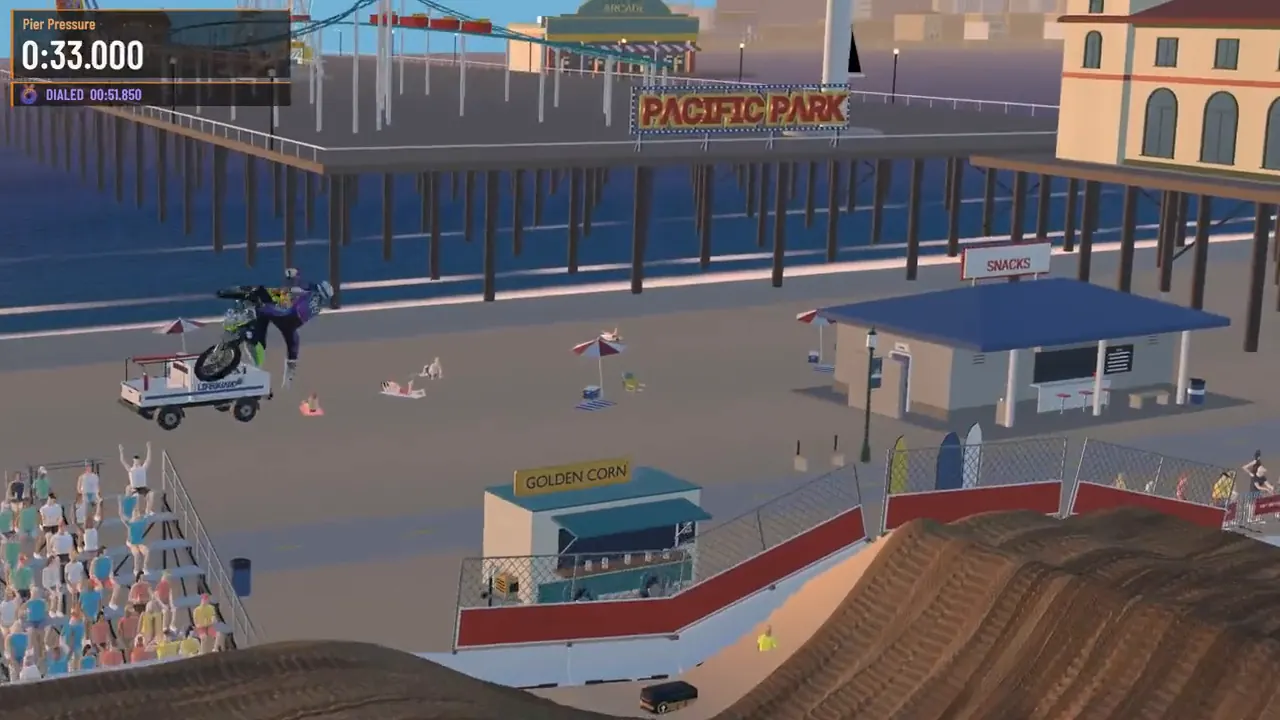
Captured in the gamePier Pressure through the camera you ride with, real speed. Every jump face, landing and whoop section you see here is the suspension doing the work.03
Scrubs, whips and oppo whips
This is the part I am most proud of, and the part that took the most tries.
Scrubs and whips are fully analog on the stick. How far you push is how fast the bike lays over, it keeps going as long as you hold it, and you bring it back yourself. There is no cap on the whip. Throw it as far sideways as you dare, as long as you get it back before you land. The oppo whip lifts the nose on its own and spins the bike the other way.
Land straight and you ride away. Land a little crossed up and you wobble. Land too far over and you are on the ground.
Getting the rider to look right in the air was a grind. Just the scrub pose, where the rider's body goes when the bike lays flat off a lip, went through more than a dozen builds: hips off the high side, chest over the bars, outside elbow up, inside foot off the peg, then the leg left to hang naturally. The whip got nine rounds. The oppo whip got six rounds in four days. Every one of those was ride it, watch it in slow motion, fix the thing that looked wrong, ride it again.
These are riding controls, not canned animations, so you can work on your own style while you chase a fast time.
Rendered by the game itselfAn oppo whip over the faire at The King's Court, straight out of the game's own replay renderer. This is the pose that took six rounds in four days.04
The places
Most motocross games put every track out in the middle of nowhere, in a field. I wanted something different, so every environment gets its own full asset pack built for the game, in a real kind of place.
Pier Pressure is a beach course at sunset right beside the pier, with the amusement park, the yacht harbor and a whole beach town behind the camera.
The King's Court is a Scottish coast. Sea cliffs, a weathered castle out on its own islet, a Renaissance faire with a staged battle going on in front of it, and the grandstand right by the first jump. It is also the hardest track in the game.
Whoopie Valley is a ski resort in summer, turned into a mountain bike park. The chairlift runs, carrying bikes up the hill, with a lodge, a village and the mountains behind it all.
Fairgrounds Afterglow is a county fair after sunset. The Ferris wheel, the carousel, the pirate ship and the midway are all right behind the fence, and the whole thing was modeled by hand.
Then there is Yukon Ridge MX, a winter night race under the Northern Lights and the Milky Way. Last Chance Salvage, a desert junkyard with eight districts and more than four hundred placed pieces of scrap. And the forest and desert tracks: Morning Woods, Timberline SX, Echo Valley MX, Slayground, Air Supply, Flatlands, Izzy's Playground, Augusta Park and Paradise Lost.
Every one of them is rated like a ski run, from Green to Double Black Diamond, every environment has its own sky, the dirt carries dozer marks, tire lines and ruts, and the game renders its own picture of every track. Those are the photos on this page. And I keep adding tracks, so this list is out of date the moment I write it.
The whole game is built to give you a reason to come back to a track and go faster.
Personal bests, one lap and three lap races, splits, race results, online leaderboards for every track, friends and friends' boards, three challenges on every course, and Bronze, Silver, Gold and Dialed medals. Dialed means you matched my own best time, and when you do it the game throws you a party.
While you ride, a live number at the top of the screen tells you how far ahead or behind your best run you are, green or red, all the way around. Whoever holds the track record runs the red number plate.
And you never chase a time alone. You can race your own best run, this session's best, a rival off the leaderboard or a friend's ghost, side by side. Pick anyone off a board and race them one on one. Those ghosts are real completed rides, so you can see their lines and where they are getting you.
Captured in the gameThe podium in the Pits after a race. Whoever holds the track record gets the top step and the red plate.06
The track editor
The editor is where the community part of this game lives.
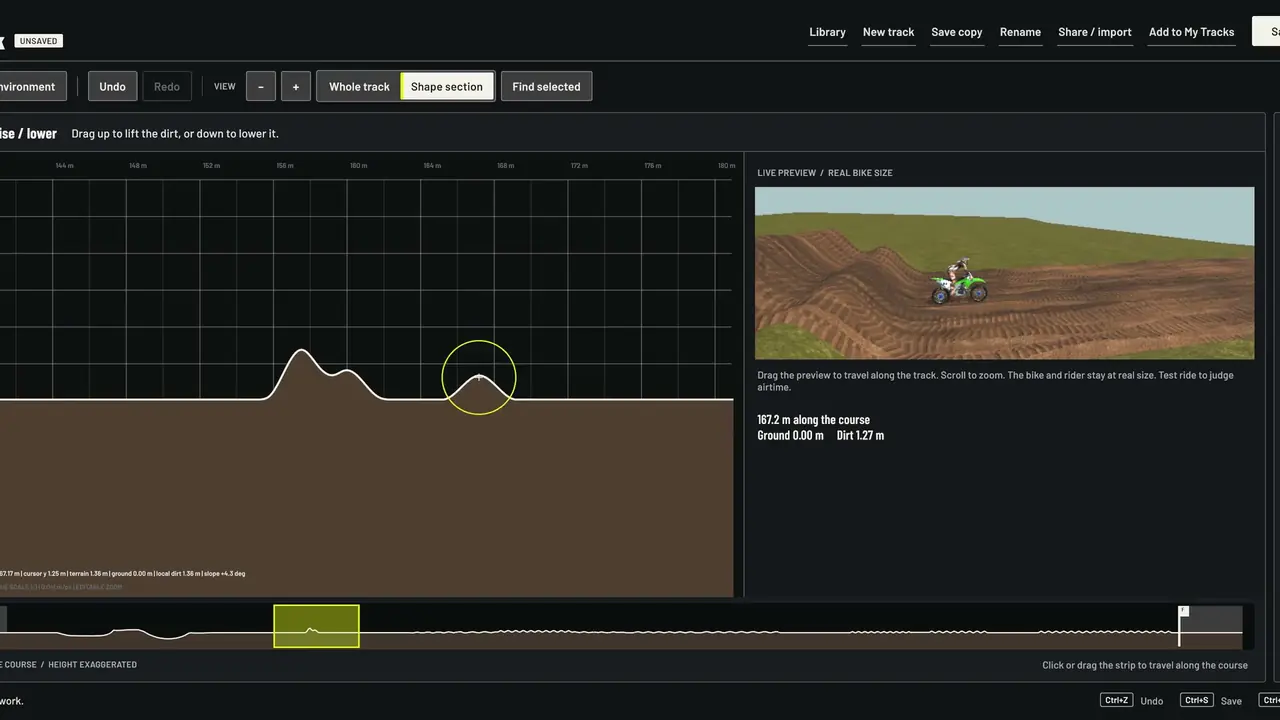
You shape the dirt with brushes, build uphill and downhill sections, and drop in any of 133 jumps and obstacles: 124 of them pulled straight off the real tracks, plus nine shapes you can stretch and reshape. You can work on the whole track or zoom into one section, with the real bike and rider standing on the ground so you can judge the size of what you are building.
Tracks do not have to be flat. Build a flat track if you want, or go big with elevation. The bike slows down climbing a hill and picks up speed running down the other side, so a track can ride like a mountain or like rolling hills in a valley.
Pick the environment, the time of day and the dirt type, and the scenery gets dressed in for you. Test ride any time and jump straight back in. Save drafts, add a finished version to your tracks, and share it with an eight character code so a friend can import it and ride it.
Every shared track gets its own leaderboard, so you and your friends can race each other's ghosts on a track you built.
Captured in the gameThe Track Editor. Shape the dirt along the profile, and the live preview shows the real bike and rider on it so you can judge the size of what you are building.07
Make the bike and the rider yours
In the Garage you paint every part of the bike on its own: shrouds, fenders, number plates, frame, swingarm, seat, gas cap, bar pad, bars, levers, chain, rims and spokes. Metal parts look anodized when you color them. You pick your race number, the plate number color and one of twelve number fonts, and you can copy and paste exact colors between parts and gear.
In the Locker you dress the rider with helmets, goggles, gear sets, gloves and boots from the game's own brands, VEKTR, FLUKE and RUCKUS, with custom colors on the patterns and saved gear sets. You can put your own name and number on the back of the jersey in one of nine lettering styles.
The Garage, part by partYour number, your fontThe LockerGoggles and gear
08
The Pits
I wanted the menus to feel like a place instead of a list, so the game has its own Pits and Race Shop.
That is where you get the bike ready, visit the Garage and the Locker, browse tracks, check records, see the podium and look through your awards. There is a full team race hauler, race bikes on stands, framed jerseys, trophies, a Sprocket Awards board and your medals on the shelf. Leave it idle and the camera takes a slow tour of the shop.
Captured in the gameThe Pits. Framed jerseys and the Sprocket Awards board on the wall, the bike on its stand, and every part of it listed down the right.09
Race day
A lot of the work is in the little things around the track.
Crowds at the big jumps throw their arms up when you fly past. Caution flaggers wave the yellow when you go down. There is a starter at the gate and a finish line official with the checkered flag, tough blocks, banners, and trackside scenery everywhere.
The rear wheel throws roost and dirt clods. The bike has moving parts, metal finishes and a pipe with real heat bluing, modeled off photos of my own pipe. The two stroke engine responds to how you ride, revving free in the air and pulling down when you touch the rear brake.
Captured in the gameSitting on the gate at Whoopie Valley, waiting on the drop. You time the start with the clutch, with the podium, the race service tent and the grandstand right there.10
Cameras, replays and photo mode
There are three ride cameras. Classic, Broadcast, which puts the bike on a long lens and dips with hard landings the way TV coverage does, and Broadcast+, which swings around behind the bike at speed and goes side on in big air.
After a ride, Watch Replay plays like an edited clip with eight cinematic cameras: a chase drone, a camera riding ahead looking back, slow orbits, a trackside camera operator, a long lens from down the track, a slow motion low orbit around your biggest air and a crane shot over the finish. Pause, rewind, step frame by frame, change the speed.
Photo Mode lets you stop any time, rewind the last five seconds, drop the camera right down into the dirt like you are standing trackside, set the lens, focus and aperture, hide the controls and save the shot.
Rendered by the game itselfA trackside replay camera catching a whip on a desert track. Every clip on this site came out of the game this way.11
Music and settings
The game has its own radio with four stations and eighteen songs, from 90s FMX jams to hip hop, dubstep and hard EDM, with separate volume for the menus and the race.
On PC there are graphics presets from Low to Ultra with auto detect, a performance overlay, controller and keyboard support, camera settings, ghost options and a reduce motion option, and a Your Data page that says exactly what the leaderboards keep and lets you delete your rider.
Captured in the gameThe main menu lives in the shop too. Ride, Bike, Locker, Podium, Settings, and the radio playing behind it all.12
Things that did not work
Part of the reason this log exists is that a lot of what you see came out of something that was wrong first.
I tried three different ride cameras and threw them all out before the one that stuck. The first whoops on the supercross track had faces steeper than any jump, so a bike could not skim them, and they got rebuilt as rollers. A raised front fender got rejected the day it went in and the original proportions came back. A framed photo of your best finish went up on the shop wall and came down two builds later because it was kind of corny. The first collection wall in the Race Shop had classic bikes on it until I decided the models were not good enough, and it became helmets and trophies instead. The starter at the gate tried three different run-offs before she just stood at the side of the track with the card.
And more than once a change I was sure about got thrown out after one ride. That is the whole point of playing the build every day.
13
Where it is now
After three months of daily builds, this is a PC motocross game with physics based riding, real tricks, a growing list of tracks that each live somewhere, a full track editor, customization, ghosts, leaderboards, challenges, replays, photo mode and a lot of personality.
It is not done, and it keeps changing. The build log below is the whole record, every build, including the fixes and the things that just did not feel right until they did. If you want to follow along, this is where I will keep posting.
Rendered by the game itselfMorning Woods, one of the newest tracks to join the game.
The build log
Build by build
The PC game, newest first. Builds have carried numbers since September 18, 2026; before that they were named by the day they shipped. Fixes and feel changes are in here on purpose, because that is where most of the work goes.
October 2026: expanding the game
Build 219
Leaderboards keep everyone's times through tuning changes: one board per track until launch, ranked by season, after 167 times on 22 courses disappeared when the crash threshold changed. Ghosts race across the season. A smoother bike on slower CPUs at high frame rates. The ship check reads each leaderboard season.
Builds 197 to 218
The track preview and race screen as two steps. The crash camera settles in without sliding sideways. A simpler challenges list and a plain Next button. No more crashes on little bumps: a hard landing now needs real air and the chassis hitting the ground. Every track opens with its preview, with no ghost in it. The finish screen reorganized. Seven My Tracks became game tracks: The King's Court, Whoopie Valley, Morning Woods, Flatlands, Air Supply, Echo Valley MX and Fairgrounds Afterglow Remake, then Slayground. My ski ratings on every track. The record red plate switch. Broadcast+, a bolder third camera. No green wall behind the camera on Forest and Desert tracks. Crash threshold tuned to 11.5 m/s, "the new sweet spot". Every track got its own loading picture, sixteen of them rendered by the game. FLUKE and RUCKUS, two new house gear brands, with every outfit and glove rebranded under them. King's Court: a jagged sea coast with cliffs and the castle in its bay, then the faire and the fight moved in front of the castle, and the grandstand beside the first jump. Fix: the rear wheel stays on the swingarm, chain and sprocket. Photo Mode rewinds the whole bike and rider. Browse every track's leaderboard on the race screen. The engine revs freely in the air and the rear brake pulls it down. Each environment got its own sky. Glove cuffs end on a clean line at the wrist.
Builds 190 to 196
The Highlands look proof: a Scottish glen with a castle, siege engines, two armies and a huge wooden horse. Smoother three-lap races and first crashes, with the game's code warmed up in the menus. Whoopie Valley's track preview made slower and more like a film: three shots with dissolves and a rider through the big jump. The Highland Faire: sea cliffs, a weathered castle on its islet and a Renaissance faire. VEKTR Crosscut redesigned from my reference set. Fix: the preview camera jerking at the first steep rise. The Tracks screen redesign with ski ratings. The Broadcast ride camera, camera settings and camera zones, and replays stop looking through the dirt.
Builds 184 to 189
Only the last second before the drop can put you into the gate. Metal parts look like metal and the pipe has heat bluing from my Bill's Pipes photos. Three-lap races run as smoothly as one lap. Audit fixes: safer saves, honest tuning ranges and one copy of the game per save folder. Race a leaderboard rider one on one, even with your own ghost off. Your Data, the privacy policy and deleting your rider.
Builds 169 to 183
Stable leaderboards: camera, whip and oppo changes never reset the boards again. Responsive Tracks previews with cached pictures. The oppo, rounds three to six: one smooth motion back to the landing, coming back gradually, coming round before the nose drops, bars toward the landing, standing up just before landing with the inside leg hanging. Smoother tricks with easing instead of fixed rates. Loose grips so the arms no longer wring in big whips. Color the handlebar, levers, chain, rims and spokes. The gate screen says "staging". Your own name on the jersey back, typed with a mouse or a controller letter board. Back on the gate returns to Tracks. VEKTR gloves for FORM, RUPTURE and CROSSCUT. The Garage zooms in on the part you are coloring. Photo Mode rewinds the front end with the bike. Replay rewinds keep whip and oppo bars right. The camera flies back into the Pits from the menus. A notice page after the title: playtest terms, ride responsibly, trademark. Gear sets tab and the VEKTR colorways back. Whoopie Valley opens with a track preview flyover. Fluorescent yellow selection marker on every bike.
Builds 155 to 168
A big center-screen celebration with confetti when you go Dialed. Dialed times re-stamped from my fastest runs. Smooth restart after a three-lap finish. Track Editor brushing and dragging went from 370 ms a frame to 7 ms, and Dress scenery opens three times faster. Fix: lap 3 of Pier Pressure sat a whole lap too far down the course, out in the ocean. Izzy's Playground got its own picture. Gloves end right at the wrist. The scrub's freed foot lifts forward with no leg swag. Marketing photo shoot cameras with real motion blur and stills. Ski Mountain: first a look proof with a lodge and a chairlift carrying mountain bikes, then the full resort, village, bike park, equipment, alpine trees and mountains for every track builder, and the lift bikes got open spoked wheels. The oppo whip, first ride: hold LB and push the stick up and to a side, the nose climbs on its own and the bike spins around. Round two: the stick around its circle steers it. Current physics leaderboards and exact run ghosts. The clip picker, where I star the clips a short is cut from.
Builds 141 to 154
The PiN tracks renamed Augusta Park and Paradise Lost. The Workshop renamed the Track Editor. 124 premade obstacles in twelve searchable groups. Yukon's stars moved up high and the aurora now rises from the horizon. A save prompt in Photo Mode. In-engine scenery screenshots for every track on the Tracks page. Scenery sits on built elevation, grandstands hold a crowd of fifty, and the Cholla Diner's roof sign reads again. Controller hints do what they say. Every lap of a three-lap race has its full venue. Izzy's Playground is a game track. Race bikes on the shop wall. The Track Editor redesigned on the number plate look. Leaderboard times: copies of official courses post to the official board, your best counts across physics updates, and a refused time waits instead of being thrown away. Get back on where you crashed, instead of being sent back to a reset point 60 m behind you. A cleaner Tracks page with the top 3 on it. Track Editor: smooth preset joins, a steady view, and opening went from a 9.4 s freeze to 0.3 s.
Builds 130 to 140
Color square and hue strip without the stalls: releases went from a two-second freeze to a few milliseconds. Ghosts saved in their own files, so a 183 MB save no longer freezes the Pits. The ship's startup check no longer touches your real save. A marketing replay renderer with four cameras, game sound and an optional HUD, and every finished ride kept so a great run can be rendered later. Number plate menus across the Pits, Tracks, Settings, the gate card, Bike, Records, Podium, Leaderboard, rider pages, pause, results, the station choice and the Locker. Three laps stay on their scenery and no crash hitch on long courses. Restarting a ride no longer freezes the game. Pier Pressure rides three laps on the same beach every lap. Ride controls moved into the pause menu. Track dirt with real dozer and tire detail: 46 dozer passes per 64 m and 64 tire lines, then re-tuned so it reads from riding distance. Choose a rider name before racing.
Builds 126 to 129
Scrub bars stay turned in and the body brings the bike back. White plate menus: one palette everywhere, charcoal ground, chalk plates, your bike color as the accent. Fix: your plate number color now carries onto the track. Twelve plate number fonts and nine jersey back lettering styles from MotocutzMX.
Builds 111 to 125
Yukon Ridge as a lit race night with a purple sky and the aurora, then it joined the game as Yukon Ridge MX with a Milky Way, sky-wide aurora and real stars, and light from the camera side at the big jumps. Fix: since rules v20, no rider's ghost had reached the boards. Solid number plates on ghosts so you know who you are racing. Independent triple clamp and hub colors, Black or White plate numbers, custom paint gloss, copy and paste exact colors, gear close-ups while you color, a Locker category rail with manufacturer browsing, editable gear patterns with custom regions, and colors that apply instantly instead of lagging. Fix: elbows twisted "like a twizzler" in tricks and replays. The idle garage camera stays inside the shop and the Pits got an idle camera tour. The Sprocket Awards board. The podium track picker with search. Softer garage contrast. The rider never lets go in the air, however far the nose drops. The race hauler: a sleeper tractor and 53 ft trailer in team livery, and the roll-up door moved so it drives straight in. The gate start position, up on the tank with boots on the start blocks. Photo Mode camera down to the ground. Lean forward off the gate: the start pad grips, full throttle wheelies, and feathering it keeps the front down. Smooth scrubs and whips in replays. The scrub's return: bars to the other lock and the rider up over the bars.
Builds 101 to 110
Rider on the legs: the rider is his own body with 62.5 kg on springy legs and a hip, so the bike rocks underneath him. My whoops setup became the stock bike after fifty runs through a track full of whoops. Steady camera on rough ground. The new-player pass after watching a friend's first session: rider name before the first ride, sharing, replay controls (pause, rewind, frame stepping, speeds and a timeline) and the gate lunge. Leaderboards for My Tracks and shared tracks, so friends race each other's ghosts on a track they built. Dressed land behind the camera for Photo Mode, out to 340 m, with a whole beach town behind Pier Pressure. Yukon Ridge in winter with an end-of-winter thaw, then Christmas lights and more snow. Three-lap races with a lap counter, per-lap splits and the white flag on the last lap. Shorter roost and fewer clods, costing less CPU.
Builds 90 to 100
Every bike part in its own color: shrouds, fenders, plates, plate numbers, frame, swingarm, seat, gas cap, bar pad and accents, plus Match all plastics. Five dirt types in the Workshop. Fuller roost, lingering haze and grounded contact shadows. Three more scrub rounds: butt back on the seat and crouched, the inside leg tucked along the bike, then the leg left to dangle naturally. Fix: the front number plate tearing at full lock. Sun lens flare removed. The ship now stamps the changelog itself. Fix: allocation tests that could never fail. Replays agree with recordings through crashes. The front fork compresses along its real raked axis, so whoops go into the spring instead of a rigid joint, and no more front throwback; then full 30 cm of fork travel. Rides are recorded only while the tuning panel is up. Big scenery sits on sloped ground, then the desert mesas too. Trackside life: caution flaggers at every big jump who wave the yellow when you crash, crowds at the three biggest jumps, and a finish-line official with the checkered flag.
Builds 78 to 89
Gloves stop at the wrist instead of running up the forearm like mittens. Photo Mode with five seconds of rewind, camera and focus controls and clean high-resolution saves. PC graphics: Low, Medium, High and Ultra presets, Detect best settings, a first-launch auto-detect and a performance overlay. Four more rounds on the scrub rider: the outside elbow up and out, the body back so the bars stay in front of the chest, sitting up straight so the arm clears the helmet, the low hand letting go so he sits on the side of the seat. The Garage trophy room with medals on the shelf and the red record plate. A framed best-finish photo on the shop wall, removed two builds later ("kind of corny"). Calmer pits lighting and optional motion blur. Timberline SX and my remake of Pier Pressure. my approved copper logo rebuilt in-world.
Builds 63 to 77
No crash lasts longer than four seconds. Fix: the check that keeps developer tools out of release builds had quietly stopped working. Hands stay on the bars in scrubs and whips, and the bars reach full lock early. The whip's bars snap to the other side on the way back. The rider's body moves in scrubs and whips: hips off the high side, chest over the bars, inside foot off the peg. Fix: automated tests had been leaving ride recordings in my real save folder. Scrubs: hips straight up over the bike, crouched lower. The starter faces the riders. One start gate with real national flags, live fire from the truss and the flat-color logo on every banner; the inflatable arch is gone. 660 MB of dead weight cut from the build. Scrubs lay over further, then further still, and flatten the jump less so a scrubbed tabletop clears. The gap to your best runs the whole ride, green or red, from the gate drop to the line. VEKTR goggles. The gate: one line of instruction, and gas without the clutch runs you into the gate, you roll back and your gate drops a second later instead of the engine stalling.
Builds 57 to 62
VEKTR, my own gear line: the FORM collection in Slate, Crimson, Cyan and Orange, then RUPTURE and CROSSCUT. The Locker remade gear-first with brand filtering and controller navigation. Free tricks: lean on the left stick, scrub and whip as stick speeds with no whip ceiling and no automatic nose. After one ride, scrub and whip moved to the right stick. The rider holds on nose down to 120 degrees so whips can drop the front end.
September 2026: building the PC game
Builds 53 to 56
The whip is one smooth motion and about 20 percent quicker. The scrub is smooth and comes back upright with the nose down. The start clutch: hold A to rev at the gate, let go to launch, let it out too early and the engine stalls. The finish line: no more freeze at the crossing, a faster fade, and the dirt continues past the line so the rider rides off into the distance.
Builds 42 to 52
The scrub: the right stick lays the bike over on a jump face for a lower, flatter flight, and the bars turn the way the bike leans. Everything in one build: weekly featured events, track challenges, friends by name or code, friends leaderboards, and holeshot starts with a starter board, a hidden random gate hold and a two-second early-launch penalty. The starter moved 15 m down the track, jumping the gate bogs the bike, and after three tries at her run-off she now simply stands at the side of the track with the card. Cinematic replay cameras: eight moving cameras, the rider centered in every shot, letterbox bars and lens blur. The whip: hold LB and push the stick, the back end throws out and up off the lip, land sideways and you crash. The whip rolls through so you land front tire first. The Race Shop collection wall: first classic bikes, then helmets and trophies after I decided the bike models were not good enough.
Builds 33 to 40
Cumulative audit fixes, Full back v3 and the finish fade. Fix: the Full back rider collapsing on jump faces. My updated riding positions. Forest and Desert as player environments and shared track basics. The rider sits in the air with no lean input and holds his shape on jump faces. Replay cameras sit closer and stay clear of the ground. Longer arms in Full back and Seated from my photos, elbows no longer fold on jump faces, and the arm skin no longer tears at the elbow.
Builds 26 to 32
Fix: stripe-like tire marks cutting through the shop floor reflections. Twenty-nine more outfits and ten glove styles. The Locker sorted by brand and part with Helmet, Goggles, Outfit, Gloves and Boots tabs. The finish ride-off: the bike rides on through the gate before the podium. Pier Pressure: a beach course at sunset beside the pier, with Pacific Park, grandstands, a beach race event and 324 people.
Builds 15 to 25
The project went PC only. Fix: a ride no longer pauses itself when a background program grabs focus. The Locker grew with its first big batch of gear, organized by brand with rendered previews. Asset review: a real drop-gate start line and my notes on every prop. Goggles became their own part with seven styles. Race your ghost side by side: your best run one lane to your left and the online rival a lane further out, each on its own dirt. Shot into the sun: backlit outdoor lighting with clearer air, sun shafts, rebuilt roost and dust, track wear, mud and cloth flutter. Goggle straps got their own color. PC video settings and a finish fade.
Builds 5 to 14
Medals and the author time. The Tracks page redesign. The first rider kit from real gear references. Fix: the click that leaves the title card no longer opens Settings. The split gap to your best shows top-center in green or red. Every ride counts, tuned or stock, and the testing-era labels came off times. Medals became real rear sprockets on a race ribbon, with the Dialed medal in burnt titanium. Results show just your time and your best; Ghost setting: Off, All-time best or This session. The gate screen waits for Let's ride. The Leaderboard became its own page. Fix: a hard landing no longer sinks a wheel under the ground. The Race Shop podium: each track's top three on their own bikes, ghosts carry their rider's plate, and the record holder runs the red plate.
Build 4
Complete bike crashes with calmer tumbles, smooth jump-face impacts, dirt and engine behavior.
Build 3
Rounded grassy banks blend foreground jumps into the landscape.
Build 1 and build 2
The first numbered PC builds: lighter dust with more chunks, a Pin button for elevation, Back to editor on test rides, a quit prompt and Click to continue. Pin holds sloped ground instead of flattening it.
Flowing elevation in the editor, so creators can build uphill and downhill sections.
Editable one-to-three digit bike numbers, then my own racing number artwork fitted to the plates. The Workshop focused building view: Whole track and Shape section, with a live preview of the real bike and rider on your terrain, and a connected reference bike that tilts with the ground. Dust and clods take the ground's real color. Race shop rendering upgrade. Front fork split into outer tube and sliding chrome section; the raised fender was rejected and the original proportions restored with front travel reduced to fit, then front spring support corrected.
PiN AMSX and PiN SMX bundled as built-in tracks. The Race Shop: an indoor DBD Factory garage bay with benches, pegboard, cabinets and Meshy-made tools, wired into the live Pits with the shop accent following your bike color.
The interactive Pits rebuild, start to finish in one day: research, Blender composition, surfaces, backdrop, woodland, reflections, cloth and metal detail, baked ground contact, collection browsing, and a Direct3D 11 switch after shutdown crashes on D3D12. Golden Hour lighting for the hub. The approved welded two-stroke pipe. My saved bike setup became the stock bike. Garage accent swatches apply only to the selected part.
Workshop keeps your view while you shape and place. Click the shelf, then click the map to place scenery. Tracks > Import track: paste a code, preview, add a riding copy. Explicit saves and confirmed deletion.
Eight-character online share codes for player tracks.
Needle Drop bundled as the third course. Beta tester feedback: clearer account states, music at 20 percent by default, drag-to-rotate in the Garage, custom plastics and three colors per gear piece. Full Back rider pose updated.
The complete Workshop overhaul: 0.1 m authoring, eight rebuilt jump profiles plus Rough, fine brushes, reset flags, equal-axis zoom, scenery handles. The bike tuning panel shipped in every PC build so testers can adjust grip, lean, power, brakes, suspension, sag, travel and crash thresholds live, with STOCK to go back. The Rider Pose Workshop authoring tool. Authored rider poses now follow the lean stick. Fix: a hotfix after keyboard and controller went dead in the tuning-panel build.
The R7 camera approved as "absolutely perfect": brief off-screen riding with a smooth push out instead of a hard cut. PC controller support with retry, pause, disconnect pause and controller menus. The two-stroke expansion chamber on the 89 bike. Sawyer Creek Race Park and the desert venue collections: forty-plus assets each, lodge, campground, sawmill, service station, diner, dinosaur visitor area. Saturation and contrast grade across the five lighting conditions ("I'm kind of a saturation guy"). Email code recovery when the mail is slow. Playable roster trimmed to the real courses. A Windows share package for the first outside tester.
Four fixed mobile buttons with remapping. An immediate crash when the bike passes vertical. Barlow fonts adopted as the game's type. The menus became a race-day timing board. A finish celebration with lamps, a count-up, horn, crowd and fireworks for a personal best. The Garage arrived: five plastics colors and rider gear per slot. The four-station radio: Smash Tooth, Dirt 808, Kill Switch and Full Gas, No Brakes, with separate menu and race music. Six (then five) lighting conditions for track creators, saved with the track and carried in share codes. Sunset retired because golden hour is prettier. Online leaderboards installed and verified with email code sign-in. Tough blocks with sponsor marks lining the Fairgrounds. My wordmark and opening artwork. Fixes: a title card that expired on the first frame, a finish sting that turned out to be a voice clip, a throttle blip merged into the sting.
A huge day. The purchased bike was refined into the green 89 bike with Dunlop tire lettering, Pro Circuit badge and Renthal bar pad, and became the default bike. The fork tubes now match the real axle travel. The crash ragdoll grew from five to eleven articulated bodies with elbows, knees and a torso. The engine sound got a shift accent and limiter dips that I called "perfect" and that stuck. The rider got smoother posture that follows lean, throttle and brake, with his boots corrected onto the pegs. Forty-nine forest and forty-eight desert plants and rocks were authored in Blender and every Forest and Desert track is dressed from them automatically, with race equipment on the Workshop shelf. Groomed track surfaces with dozer marks and transition ruts, approved after a first version was rejected. Dust and roost. The pits got the team tractor and trailer, and the game got its first native home, track selection, records, settings and finish screens. Fixes: airborne wheel lock on throttle release, a rear wheel trapped under the ground, the finish time staying fixed at the line.
Last Chance Salvage, a 600 m course through eight desert salvage-yard districts with 418 placed pieces. The junkyard scrap was made readable: doors, buckled hoods, rims and exhausts instead of generic fragments. The tire mountain was rebuilt from a proper shaped car tire. START and FINISH arches moved across the actual track and the start gate now holds through the countdown and drops at GO. Shape track and Dress scenery modes in the Workshop with four environments, suggested layouts, grounded dragging, search, rotation and duplication. One installed desktop game with a shortcut that always points at the newest verified version. Engine braking and crash threshold tuned to my startup defaults.
The Track Workshop shipped as a private PC build: draw, raise and lower, flatten, smooth, select and move, eight editable obstacle families, mirroring, duplication, undo and redo, rulers, a whole-track navigator, a local library, templates, share codes and a test ride that returns you to exactly where you were. Fairgrounds Afterglow got its animated fairground: a Ferris wheel, carousel, swing ride, pirate ship, giant slide and midway, all modeled in Blender. The phone controls got a thumb-control trial.
Real-world scale locked in after riding a full-size test track against a two-thirds one. The bike's speed ceiling was set to 42 mph. SX Main Event, a 600 m supercross lap, was built from the measured jump envelope. After riding it, the whoops were rebuilt as rollers a bike can skim: the faces were 45 degrees, steeper than any jump on the track. The crash now holds until the rider stops sliding, capped at four seconds. Forest and desert scenery packs for future tracks.
The 3D bike and rider came into the game, with six authored riding poses that respond to the bike. Crashes became visible: the five-body ragdoll had been simulating under the hood with nothing drawn, so the rider now tumbles instead of sitting frozen on a flipping bike. The crash rider no longer collides with his own bike.
The riding camera gained predictive framing so the bike and the terrain ahead stay on screen. Engine audio cleanup began: the whole off-throttle sound is now one engine. Restart now fires on the press instead of the held key.
August 2026: the Unity game begins
The first full pass on Windows and on a phone. Three camera designs were tried and rejected before one stuck.
Gamepad controls, suspension forces, engine braking, landing impacts, ragdoll crashes and bike setup controls.
The first complete private playable Unity build, with a cinematic camera that followed the bike and adjusted to the terrain.
First bike physics in Unity, terrain, a timed race loop, and the foundation for recording and replaying rides step for step.
Work started on the native Unity project. The track format and the tools to read tracks came across from the browser game, so a track built in one could be read by the other.
Before the PC game
The original browser game
A separate, smaller thing. Read this only if you want to know where it all came from.
Before any of this, Dirt Bike Dialed was a little game you could play in a web browser. I started it on July 2, 2026, tried a few ideas that did not work, including a track seen from an angle and a 3D stadium, and landed on a side-on view with real bike physics underneath it. Throttle, brake, lean the rider, hit the jump and see what happens.
In four weeks it picked up a bike and rider, engine sound, dust, a following camera, a countdown, results, a track editor, online leaderboards, medals, ghosts and a community track gallery. By the end of July it was obvious the browser could not take the game where I wanted it to go, so I started over in Unity.
That browser game is still free to play, and it is a separate thing from the PC game. The PC game took the track format and the ride, crash, restart, chase your time loop from it, and everything else was built new.
The original browser gameThe browser game, July 2026. Still free to play.Play the browser gameThe browser game, day by day
The first Dirt Bike Dialed game experiments. Early prototypes explored hills, whoops, a perspective-based track and a 3D stadium with a dirt bike.
The game found its direction: a side-view motocross game built around bike physics. The first playable version had throttle, braking, rider lean, suspension, jumps, crashes, restarting, a race timer, a following camera, a countdown, results and personal best times, on keyboard or touch.
A daylight world, bike and rider artwork, wheels, trackside scenery, rear-wheel dust, a new interface and sound effects.
The first track editor: draw and shape dirt, flatten or smooth terrain, undo, save drafts and test ride. Track selection, sharing and remixing. The camera started adjusting during jumps to show the landing.
Rider names, online leaderboards and short track links. More named tracks, difficulty badges and importing a shared track.
Rider rankings, medals, track record holders and a target showing the next rider to beat. More visible suspension movement.
A bigger visual update: better skies, distant scenery, detailed dirt, landing dust, roost and updated race presentation. A community track gallery.
A library of premade jump shapes and a whole-track navigation view in the editor.
WhoopApocalypse added as a built-in track.
Multiple scenery environments for track creators, carried in share links.
Featured community tracks, post-race track discoveries, festival-style scenery and more built-in tracks.
Illustrated foreground terrain, a finish-line arch and a retro supercross setting.
A featured daily ride and more trackside sponsor decorations.
Rival Tour progression and championship standings, a redesigned track menu and community board.
Race against a ghost of your own personal best. The first soundtrack.
The soundtrack grew to four songs.
The decision to build a native Unity version of the game.
Follow along.
The game is in development for Windows PC, coming to Steam. This page grows with every build. The original browser game is still free to play while you wait.